

Identifying and Quantifying Markets
A Seeding Company Exploring Target Regions for Ozone-Resistant Crop Cultivars
The Question
Ozone exposure drives persistent yield losses of 15–19% in oilseed rape across Europe, and up to 40% in wheat, with significant variation between regions. Even modest regional differences can equate to millions of euros in lost grain output, making investments in ozone-tolerant cultivars commercially attractive and likely to deliver a strong return on investment. A seeding company wants to explore target regions for new ozone-resistant cultivars, estimate potential market volumes, and eventually develop more targeted marketing strategies.


The Solution
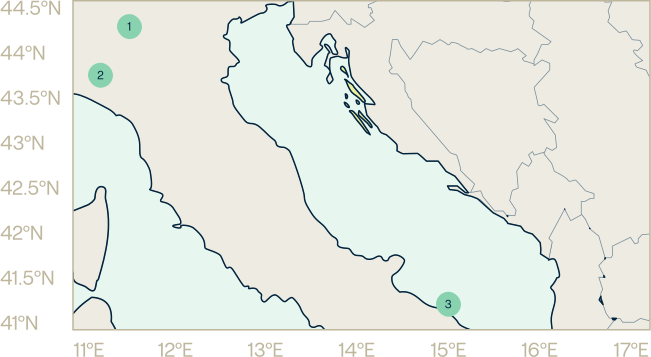
By using our technology and data, the seeding company gains insights in current and future yield losses across several locations of their choice. For this case study, we assumed that crop type, management practices, and growing season are consistent across all sites. Consequently, observed differences in yield loss reflect spatial variation in ozone exposure rather than differences in climate, weather, or farming practices.
The Insight
All European sites show chronic ozone stress, leading to stable but substantial losses year after year. Eastern European and Italian sites experience the highest losses due to stronger summer ozone episodes and higher background levels. Persistent ozone stress can amplify other agronomic pressures, including increased nutrient demand and greater susceptibility to biotic stress.Developing and offering ozone-tolerant cultivars for these highly affected regions could be commercially attractive for a seeding company as such cultivars can deliver a strong return on investment for farmers. The seeding company may consider focusing its efforts on these regions, provided there are no other agronomic, legal, or economic reasons against it.
Large European Multisite Farm
Site locations

Italian Wheat — 3 sites
Site locations
Project annual yield loss due to ozone
Large European Multisite Farm
2025 — 2050

Project annual yield loss due to ozone
Italian Wheat — 3 sites
2025 — 2050
